
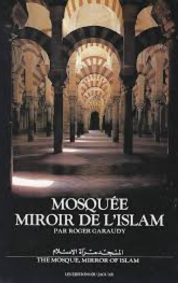
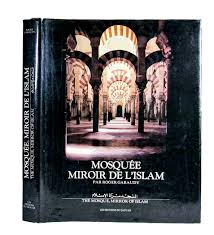
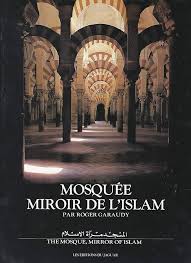
In this volume, Garaudy explores the mosque not simply as a building, but as a “mirror” of Islam — a symbol and embodiment of Islamic faith, culture, spirituality and civilization.
He approaches the mosque from two broad but inter‑related perspectives:
1. Historical / Civilizational: He traces how Islamic civilization spread across continents, how mosques became visible markers of that expansion, and how they incorporated, adapted and expressed diverse regional architectural traditions. For example, he links the mosque form to the early growth of Islam and the creation of a communal religious‑civilizational identity.
2. Religious, symbolic & aesthetic: Beyond mere function, Garaudy emphasizes how every major element of the mosque (orientation towards the Ka’ba, the niche/mihrâb, minaret, calligraphy, ornamentation, geometry, light and space) carries deeper meaning. These structures, in his view, reflect submission (Islam means “submission”), the presence of the divine, and the believer’s relation to God and community.
Thus the book presents the mosque as a living sign — it is both visible (built, material, architectural) and invisible (spiritual, symbolic, ritual). Through that dual lens, Garaudy invites the reader to see mosques as more than monuments: they are affirmations of faith, expressions of cultural identity, and spaces of transcendence.
He also argues implicitly that modern Muslims can draw from this rich architectural and aesthetic inheritance to develop a present‑day culture of beauty and spirituality — not by mimicry of the West or simple nostalgia, but by re‑awakening the mosque’s deeper meaning in our times.
The book is richly illustrated, showing major mosques around the world, giving the reader visual engagement with what the text explores conceptually.
—
Who might benefit from reading it?
Anyone interested in Islamic architecture and how it reflects faith and civilization.
Readers wanting to understand how sacred spaces function symbolically as well as practically.
People curious about the intersection of religion, art, and culture in the Islamic world.
Those exploring how built form (architecture) can embody worldview and meaning.
Main Sections & Themes
From the Google Books entry:
Preface by Dr. Nassif (President of the World Islamic League)
Table of Contents (partial listing) shows a chapter: “Islam: religion of beauty”
—
The two‑part structure (as referenced in a film‑adaptation synopsis)
Based on a synopsis (of the film project) of the book’s themes:
Part 1: The Visible – “The Mosque in the History of Islam”: explores historical expansion of Islam and how the mosque functions in society, architecture and culture.
Part 2: The Invisible – “The Mosque: or Submission to God”: focuses on the spiritual / symbolic dimension of the mosque, its ritual meaning, orientation, elements like mihrâb, minbar, minaret, etc.
—
Sample Chapter Topics (inferred)
From the synopsis and table of contents hints:
Islam as a religion of beauty.
The mosque as a symbol of faith and community.
The expansion of Islam via the built form of the mosque: historical and civilizational context.
Regional and stylistic diversity of mosque architecture (e.g., Middle East, North Africa, Spain, India).
Liturgical and symbolic elements of the mosque: orientation (qibla), minaret, mihrâb, calligraphy, geometry.
The relationship of Muslim communities to architecture and art — an authentic aesthetic rooted in faith rather than mere imitation.
Reviews
There are no reviews yet.